Pathogen Evolution & Disease Emergence
Why do some microorganisms become pathogens, expand into new geographic regions, or begin infecting new hosts? Our lab studies disease emergence as an evolutionary and ecological process, integrating systematics, phylogenetics, genomics, historical collections, and experimental biology to reconstruct where pathogens came from, how they spread, and how interactions with their hosts and other microorganisms shape their evolution.
Accurately defining species and populations is fundamental to understanding pathogen emergence. Organisms that appear nearly identical can differ substantially in host range, geographic origin, and evolutionary history, meaning that unresolved taxonomy can obscure the processes driving disease (Bradshaw et al. 2026, Plant Disease). Our work on powdery mildews has revealed cryptic host specialization and shown how closely related pathogens can follow very different evolutionary trajectories. Using historical specimens collected across 28 countries, we reconstructed the global spread of the blueberry powdery mildew complex and linked its movement to the expansion of cultivated blueberries (Bradshaw et al. 2025, New Phytologist). Similarly, our work on strawberry powdery mildews revealed distinct North American and Eurasian lineages with independent evolutionary histories on their hosts (Crouch et al. 2026, Proceedings of the National Academy of Sciences).
Natural history collections also allow us to determine when emergence actually occurred, which can be decades before a pathogen is recognized as invasive or economically important. Our research has used historical specimens to uncover previously hidden invasions of fungal pathogens in North America. Work on the invasive maple powdery mildew Sawadaea bicornis revealed an extensive invasion of native bigleaf maple and historical specimens documenting its presence in North America many decades before the scale of the invasion was recognized (Bradshaw et al. 2021, Fungal Biology). More recently, historical collections showed that Erysiphe quercicola, an important pathogen of oaks and other plants, was present in the United States for decades before its distribution and potential significance were recognized (Bradshaw et al. 2026, Forest Pathology). These studies demonstrate that pathogen emergence is often a prolonged process and that historical collections can provide an early-warning framework for identifying introduced lineages before their impacts become obvious.
We are also interested in how evolutionary history shapes interactions among microorganisms. Fungi exist within complex communities where competition and cooperation can alter growth, pathogenicity, and secondary metabolism. By combining accurate species identification with our living fungal collection, phylogenetic information, and experimental interaction assays, we can ask whether particular interaction phenotypes and chemical strategies are conserved across evolutionary lineages or have evolved repeatedly. These approaches allow us to identify microbial interactions that might otherwise remain hidden and investigate how coevolution and competition generate biologically active chemistry.
Ultimately, our goal is to move from documenting disease after it appears toward understanding and anticipating the evolutionary processes that produce emerging pathogens. By combining contemporary sampling with historical collections and integrating organismal biology with genomic and experimental approaches, we aim to identify the signatures of host shifts, geographic expansion, and changing microbial interactions that accompany disease emergence.
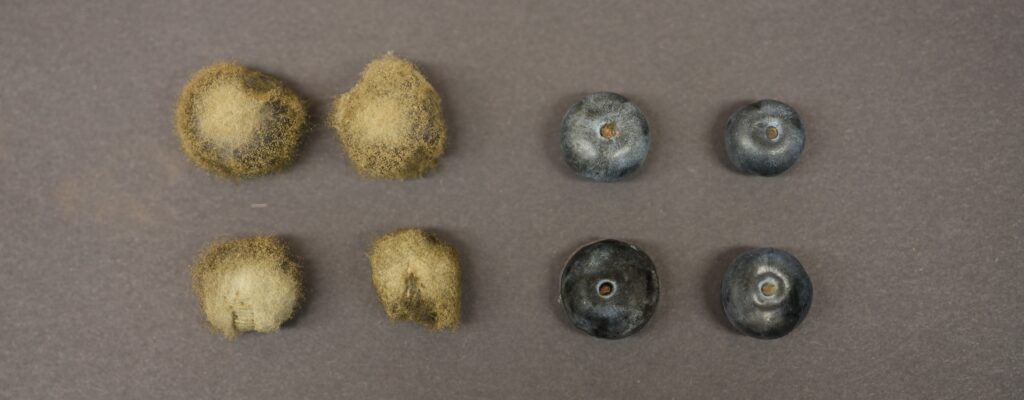
Botrytis inoculated blueberries next to inoculated blueberries treated with common synthetic fungicide. Image by Uma Crouch and Bailey Pelt